
A violation letter is a deadline, not a death sentence.
Permit violation resolution in Miami-Dade & Broward, Florida.
A Notice of Violation is a written citation from a code-enforcement authority. It identifies the cited section of the Florida Building Code, County Code, or municipal ordinance, states what must be corrected, and sets a cure-period deadline (typically 15 to 90 days). If unresolved, the case can proceed to a Special Master hearing under Florida Statute §162.09, where civil penalties may be imposed and unpaid assessments may be recorded as liens against the property. Amounts, appeal rights, and mitigation processes vary by jurisdiction — confirm from the specific notice.
Most violations are resolvable — including building recertification deficiencies, unpermitted work, expired permits, and zoning citations. The cost of resolution does not typically increase the longer you wait; the cost of inaction can.
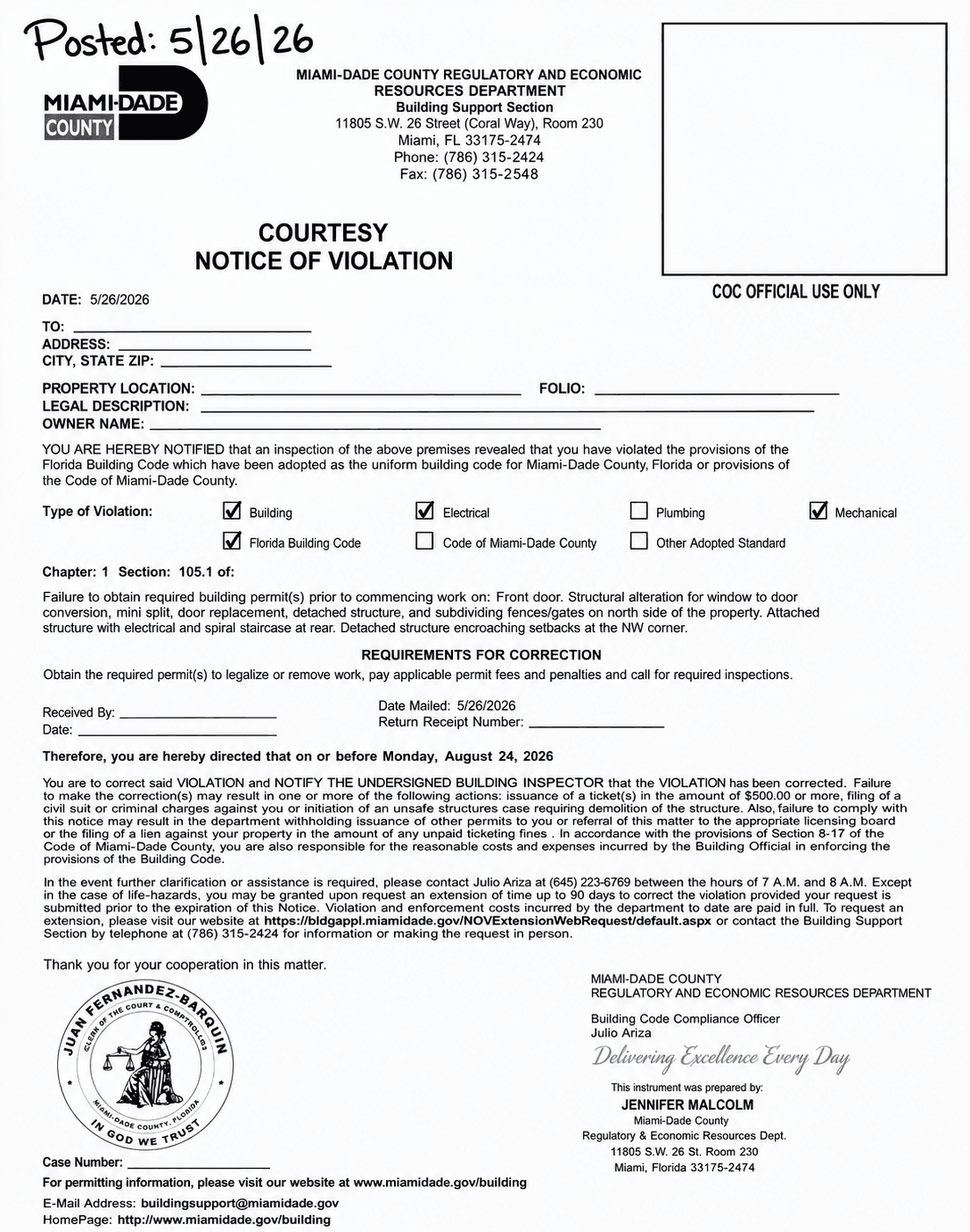
Most violations look something like this.
“…you are hereby notified that the following violation(s) of the Florida Building Code and/or Miami-Dade County Code exist on your property. You are directed to obtain the required permits within ___ days…”
The letter cites specific code sections and the deadlines are real. Depending on the governing ordinance and case type, civil penalties or daily fines may begin accruing once the cure period lapses — amounts, commencement dates, appeal rights, and mitigation processes must be confirmed from the notice and applicable jurisdiction.
What the letter doesn’t say is which violations have a clear resolution path and which don’t. That’s the part we do. If you don't yet know whether a notice has been issued on your property, you can find open violations on any property through the Miami-Dade public record. And if the underlying issue is working without a permit in South Florida, the after-the-fact pathway is usually the resolution route.
For properties in the City of Coral Gables specifically — where the Board of Architects and Historic Preservation Board add layered review — see our dedicated Coral Gables code violation removal guide.
Five violations we see most often.
Work without a permit (WWP)
The single most common citation. An inspector observed construction, alteration, or installation that required a permit but was performed without one. Resolution path: legalize via after-the-fact permit (if code-compliant) or remove the work and document compliance.
Expired or unfinaled permit
A permit was pulled but never finaled. The system flags it after the expiration date. Resolution: schedule and pass the missing inspections, address any field corrections, close out the permit. Common at sale and refinance.
Building recertification deficiency
Miami-Dade's building recertification program generally begins at 30 years inland and 25 years for qualifying coastal buildings, with recertification at 10-year intervals under Section 8-11(f). A failed structural or electrical report can trigger an unsafe-structure determination. Resolution: coordinate engineering, document compliance, resolve the file with the Building Official.
Unsafe structures / minimum housing
Code enforcement observed conditions that violate minimum-housing or unsafe-structures provisions — typically roof, electrical, life-safety, or structural issues. Resolution: scoped repair under permit, with inspections.
Fence, setback, or zoning violation
Most often a fence that exceeds height limits, encroaches on a setback, or doesn’t match approved drawings. Resolution: survey, drawings, variance application if eligible, or alteration to bring into compliance.
Whatever the trade, we resolve the file.
Permit violations come in every trade category, not just the structural and accessory-building cases that dominate our case studies. Electrical violations, roofing violations, plumbing citations, mechanical/HVAC issues, shed and accessory-structure violations — we resolve all of them through coordination with licensed professionals in our South Florida network.
Electrical
Panel upgrades, service entrance, GFCI retrofits, rewiring, generator installation, EV charging circuits.
Roofing
Re-roofs, repairs, post-storm replacements, 25-year insurance inspections, NOA-compliant materials.
Plumbing
Water service, drainage, gas line work, fixture replacements, sewer line repairs.
Mechanical / HVAC
Air conditioning, ductwork, fresh-air requirements, fuel-fired equipment, mini-split installations.
Structural
Additions, foundation repairs, hurricane retrofits, beam replacements, balcony repairs, recertifications.
Sheds & Accessory Structures
Garden sheds, ADUs, detached garages, workshops, gazebos — including after-the-fact legalization.
Windows & Doors
Impact-window replacements, slider doors, hurricane shutters, HVHZ NOA documentation.
Pool & Spa
Pool construction, deck enclosures, safety barriers, electrical bonding, screen enclosures.
Fences, Decks & Pergolas
Property-line fences, CBS walls, decorative iron, raised decks, pergolas — common after-the-fact category.
How the coordination model works. Permit Solutions Services is not a licensed electrician, roofer, plumber, or general contractor — we coordinate Florida-licensed professionals from our South Florida network for each trade. Our role is permit resolution, scope coordination, code interpretation, inspection management, and closing the file with the municipality. The trade work itself is performed by the licensed specialist appropriate to each case. For each project we tell you which licensed professional will perform the work, what their fee is, and how the timeline runs — the trade fee is separate from our coordination fee and flows directly to the contractor.
What “fast” actually looks like.
Planning estimates only. Actual timelines depend on document availability, design and engineering requirements, property condition, owner response time, municipal workload, reviewer comments, inspections, corrective work, hearings, and other factors outside Permit Solutions' control. A specialist provides your case-specific window in writing at intake once the record has been reviewed.
| Case type | Typical resolution window |
|---|---|
| Expired permit, no field issues | 3 – 6 weeks |
| Work without permit, fully legalizable | 8 – 14 weeks |
| Code-enforcement file with recorded lien | 12 – 24 weeks |
| Building recertification deficiency requiring engineering | 16 – 32 weeks |
| Unsafe-structures case requiring engineering | 20 – 40 weeks |
Delay can increase financial and transactional risk.
Depending on the governing ordinance, violation history, hearing status, enforcement order, and jurisdiction, civil penalties or daily fines may be imposed. An unresolved matter may also result in additional enforcement action or a recorded lien. The amount, commencement date, appeal rights, cure period, mitigation process, and effect on a property transaction must be confirmed from the notice, municipal record, and applicable law.
Kendall • Inherited NOV + Recorded Lien • Closed 2025 “The lien was recorded against the property before we even bought it. Permit Solutions read the file, identified what was legalizable, filed the work, and got the lien released. We closed the sale ninety days from engagement.”
Permit Violations in Miami-Dade: Common Questions
What happens if I did work without a permit in Miami-Dade?
Work done without a required permit is a code violation. If discovered, the county or city can issue a citation and a stop-work order, and you'll generally need to legalize the work through an after-the-fact permit — including inspections and added penalties — to bring the property back into compliance.
What is a stop-work order and how do I lift it?
A stop-work order legally halts all construction, usually because work is proceeding without a permit or outside its approved scope. To lift it you typically apply for the proper permit, pay any penalties, and pass the required inspections. We manage that process so work can resume as quickly as the rules allow.
How much are the penalties for building without a permit?
Miami-Dade and its municipalities generally add a penalty for work started without a permit — often an investigative or penalty fee on top of the normal permit cost — plus daily fines if a violation case is already open. The exact amount depends on the jurisdiction and scope.
Can I be held responsible for unpermitted work a previous owner did?
It can. Open permits, unresolved violations, and recorded liens can affect a current owner or a future transaction even when the original work was performed by someone else. The specific legal effect depends on the type of matter, recorded instruments, municipal procedure, contract terms, and applicable law — which is why these issues often surface at closing or refinance. We help new owners research and resolve inherited compliance matters and clear the record; legal and title questions should be reviewed by qualified counsel or a title professional.
How do I resolve a permit violation?
The path is: pull the property's permit history, identify every open or missing permit, apply for the after-the-fact permit(s), complete inspections, and get the case formally closed. We handle each step so you don't have to navigate the county process yourself.
Send us the letter. We’ll send back the resolution path.
Upload the NOV, the code-enforcement letter, or the lien notice. A specialist reviews and returns a written resolution path within one business day — including the cited code sections, the steps to close, and a realistic timeline.
Your documents are reviewed by a specialist. We never share details without your consent.